


While environmental factors are rarely considered to be the sole cause of conflict, competition over natural resources can, often, become a significant driver of serious clashes. According to the United Nations Environment Programme (UNEP), in the past 60 years, at least 40 per cent of all intrastate conflicts have a link to natural resources, and that this link doubles the risk of a conflict escalation.
Since 1990, at least 18 violent conflicts have been fuelled by the exploitation of natural resources, whether ‘high-value’ resources like timber, diamonds, gold, minerals and oil, or scarce ones like fertile land and water. Climate change is also seen as a ‘threat multiplier’, exacerbating threats caused by persistent poverty or weak resource management.
In Darfur, where the lack of sufficient water sources is one of the primary non-political causes of the ongoing conflict, the African Union-United Nations Mission in Darfur (UNAMID) and UN agencies are working close with local institutions and communities to address environmental degradation.
The Department of Peacekeeping Operations notes that the deployment of thousands of civilian, police and military personnel within a peacekeeping mission requires a large amount of logistical support. Often countries in which peacekeeping missions operate have very basic infrastructure and UN personnel produce liquid and solid waste which, if not treated and disposed properly, can have a negative impact on the local environment. In this context, UNAMID is developing landfills and controlled tipping sites for treatment of waste disposal in Darfur.
Emmanuel Mollel, Chief, Water and Environmental Section, UNAMID, says that the Mission’s waste management systems include waste reuse, recycling and final disposal. “Waste is being sorted into three streams—organic or food waste; recyclables (plastic, glass bottles and juice boxes) and; residues. Each category of segregated waste material is collected and treated using appropriate methods,” he adds.
Additionally, every week, some 1000 cubic metres of solid waste is collected using 31 garbage collection skips and 23 garbage trucks, and trucked to designated disposal sites, while four cubic metres of compost is produced from the food wastes and 500 tree seedlings are nursed using-used juice boxes. Presently, seven controlled tipping sites and two landfills are being developed.
Mr. Mollel also reveals that 120 waste water treatment plants are being operated to produce recycled water. Each week some 14,000 cubic metres of recycled water is used by the Mission for non-potable purposes, such as flushing toilets, watering plants, mixing mortar, controlling dust and fire-fighting.
As part of the UN’s ‘greening the blue’ initiative, UNAMID has installed solar powered streets across its bases and team sites and is using solar water heaters and solar-driven pumps. The Mission has also developed and rehabilitated water sources, including hafirs, dams and rihoods, to provide local communities with better access to this precious resource. In addition, the Mission harvests rain water for its use. “UNAMID has 2,000 square metres of rainwater harvesting roofing area. Associated infrastructures have been installed in five super camps, producing some 6,000 cubic metres of water annually. Moreover, three dams—Sail Gassa, Seraigay and Takaro—have been rehabilitated, to sustain boreholes’ yields and provide water for livestock,” adds Mr. Mollel.
UN agencies contribute significantly to preserving the environment globally. In Darfur, in collaboration with the local authorities, civil society organisations and communities, work is ongoing in a 50km stretch of the Wadi El Ku water catchment, near El Fasher town, to rehabilitate natural resources and to get all actors working together for better, more integrated management of the environment.
This three-year project, sponsored by the European Union, will include development of inclusive natural resource management systems and structures with a particular focus on water, promotion of better livelihood practices and techniques at community level, building institutional capacities to enable improved livelihoods support to producers and to implement and replicate successful integrated natural resource management.
5 June is celebrated as World Environment Day which is the United Nations’ principal vehicle for encouraging worldwide awareness and action for the environment. Over the years it has grown to be a broad, global platform for public outreach that is widely celebrated by stakeholders in over 100 countries. It also serves as the ‘people’s day’ for doing something positive for the environment, galvanizing individual actions into a collective power that generates an exponential positive impact on the planet.
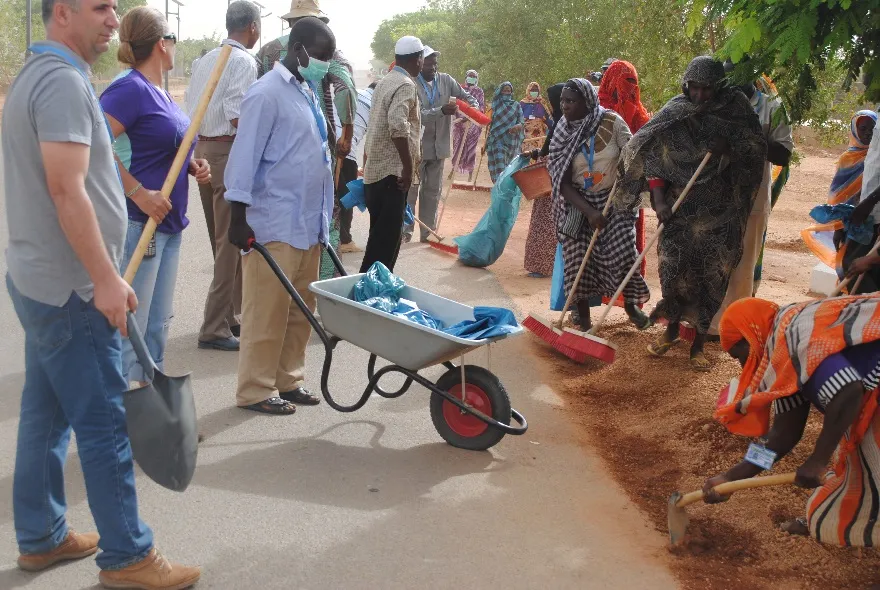
On 4 June 2015, UNAMID Sector West leadership and staff conduct a cleaning campaign along with the local community on the occasion of the World Environment Day. Photo by Muntasir Sharafadin, UNAMID.


